
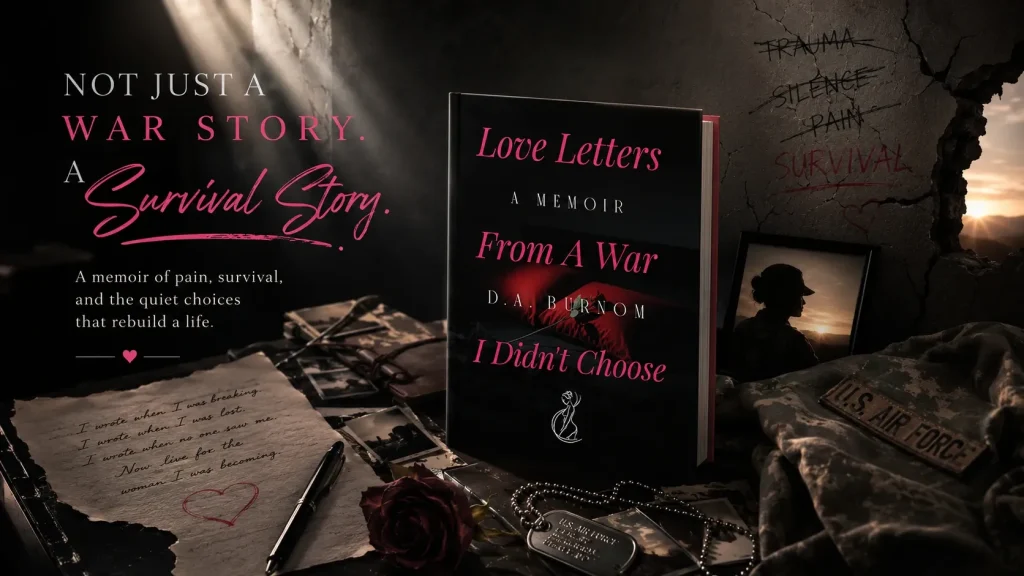
Some books don’t ask to be enjoyed. Instead, they ask to be survived alongside. Love Letters From A War I Didn’t Choose A Life-Changing Book is exactly that kind of read. It doesn’t offer a tidy ending. It doesn’t tie a bow around trauma either. Instead, it hands you the messy middle and asks you to sit there for a while.
Inside the Love Letters From A War I Didn’t Choose Life Changing Book
So who wrote something this honest? D.A. Burnom served 24 years in the United States Air Force. Along the way, she earned three master’s degrees. She also built a real estate portfolio from nothing. But none of that is really her biggest achievement. Her biggest achievement, plainly, is that she survived.
She endured military sexual trauma. She went through three divorces, job loss, and a period of suicidal crisis that nearly took her life. Rather than hide any of it, though, she chose to write it down. That choice became this book. It’s a big part of why so many readers call it unforgettable.
A Structure Built Like a Diary, Not a Novel
Here’s what makes the format unusual. The book unfolds as journal entries spanning several years. Because of that, it reads less like a polished story. Instead, it feels like something private you weren’t quite supposed to see. Each chapter closes with a short reflection section. There, Burnom explains what she learned and why she kept going anyway.
That structure matters a lot. Instead of smoothing over the hard years, it lets them stay rough around the edges. So you see her fail. You also see her fight. Then, somehow, you see her refuse to quit, chapter after chapter.
Why It Reads Like One of the Best Emotional Poetry Books
Even though this is a memoir, the language often feels closer to verse than prose. Sentences stay short and aching. Then long silences sit between them. That’s likely why readers keep placing it alongside the best emotional poetry books on their shelves, even though it’s technically shelved as memoir.
Burnom doesn’t sanitize her anger anywhere in these pages. She doesn’t hide her depression either. Instead, she owns all of it, plainly and without excuse. That kind of honesty is rare. It’s exactly what elevates simple journal entries into something closer to real, felt poetry.
The Weight of Unspoken Things
Plenty of writers describe pain from a safe distance. This one doesn’t do that. Instead, she writes from directly inside it, which is a much harder thing to pull off well. So her work sits firmly among modern emotional poetry books, even while it tells a very grounded, real-life story.
Meanwhile, readers looking for deep meaningful poetry books tend to find something unexpected here. It’s not metaphor for metaphor’s sake. Instead, it’s survival, written in real time, with nothing softened for comfort.
A Book That Doesn’t Look Away
According to the U.S. Department of Veterans Affairs, military sexual trauma remains a serious and underreported issue among service members. So storytelling has become one meaningful way survivors process what happened to them. Burnom’s book fits squarely into that larger conversation. It gives voice to something many survivors carry silently for years.
This is also why the book resonates as a powerful emotional poem book in spirit, if not strictly in form. The Discovery sections at the end of each chapter work almost like closing stanzas. They draw meaning out of chaos, instead of just describing the chaos itself.
Real Readers, Real Reactions
One reviewer, who isn’t a veteran herself, said the book’s honesty around single parenthood and financial struggle hit closer to home than she expected. Another called it a rare balance of trauma and triumph, where neither one erases the other. That balance is a big reason people keep calling this a real emotion poetry collection book, even while praising it as memoir.
Because the writing never oversells hope or undersells pain, it also earns its place among mindful spiritual poetry book recommendations. There’s a quiet, reflective quality running through it. It’s less about religion specifically, and more about staying present with hard feelings instead of running from them.
Who Should Actually Read This Book
Honestly, this book isn’t for everyone looking for a light weekend read. But if you’ve ever felt like your struggles were too messy to talk about, this one might feel like relief. Veterans will recognize pieces of themselves here. So will single parents juggling too much on too little sleep. Even readers with no military background often say the emotional core still lands hard.
It also works well for anyone drawn to memoirs that don’t flinch. If you want comfort food fiction, look elsewhere. But if you want something true, this book delivers that in full.
Why This Book Matters Right Now
So many memoirs about hardship rush toward redemption too fast. This one refuses to. Instead, Burnom shows readers that healing isn’t about erasing scars. It’s about learning to carry them without letting them define everything else. That message lands especially hard for veterans, single parents, and anyone quietly rebuilding after loss.
Plus, the book never asks readers to be unbreakable either. Instead, it makes room for both the bad days and the good ones, sitting side by side without contradiction. That honesty is exactly what turns a personal memoir into something closer to universal.
Final Thoughts
At its core, this Love Letters From A War I Didn’t Choose life-changing book proves something simple but easy to forget. Survival doesn’t require being unbreakable. Instead, it just requires choosing, again and again, to put yourself back together on your own terms. So if you’re looking for a read that’s honest, raw, and ultimately hopeful without ever faking it, this book deserves your time. Pick up a copy, and give yourself space to sit with it.
FAQs
What is Love Letters From A War I Didn’t Choose about?
It’s a memoir told through journal entries. It follows the author’s experience with military sexual trauma, financial collapse, and a period of suicidal crisis, along with how she kept choosing to survive.
Is this book only for military veterans?
No, it isn’t. While it speaks directly to veterans, many readers without military backgrounds say the themes of single parenthood, financial struggle, and mental health still resonate deeply.
Why do people compare this memoir to poetry?
The prose style stays short, emotional, and reflective. So it carries a lyrical quality readers often associate with powerful poetry collections, even though it’s technically a memoir.
Does this book offer a hopeful ending?
It offers something more honest than a neat resolution. Instead, it shows ongoing survival rather than a finished, tidy recovery, which many readers find more believable and more comforting.